Market View
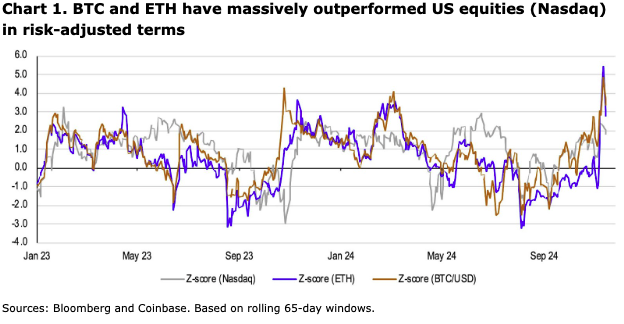
Bitcoin pulled back after breaching a new all-time-high of $93k this week. The token’s almost 30% appreciation since the US elections represents a massive four standard deviation move compared to its average price over the previous 65 days. This far outpaces the two sigma moves happening in US equities (proxied by the Nasdaq) over the same period. Average daily volumes across global centralized exchanges have totaled US$26.8B in the spot market and $88.8B in the futures market month-to-date, approximately doubling the activity observed in October. All of this has contributed to a surge in the stablecoin market cap from $174B on November 4 to $181B as of November 13, highlighting the improved liquidity in this space.
Some supply overhangs do remain, however. For example, more than half of the US government’s supply of bitcoin (around 120k BTC worth around $10.6B today) may be returned to Bitfinex in the near future, as the exchange was deemed the “sole victim” of the 2016 hack in early October. The sentencing for Ilya Lichtenstein, the hacker responsible for the exploit, was due to take place on November 14, which may bring more attention to the ultimate restitution date for Bitfinex. The timing is key, as President-elect Donald Trump has previously proposed a Bitcoin Strategic Reserve to be funded with the US government’s existing BTC holdings. Although there’s still uncertainty around how Bitfinex’s funds may be distributed to former account holders, we think the current bitcoin momentum could relieve the pressure around any announcements here.
Ultimately, we retain the constructive crypto outlook for 4Q24 that we posited back in July and August 2024, with the view that this could be extended into 1Q25. Although the market continues paring back the odds of a Federal Reserve cut in December, we believe that relatively looser monetary conditions will persist, even if future decisions will be made in the shadow of the recent elections. (Indeed, CPI data for October came in line with expectations at 2.6% YoY headline and 3.3% core, but markets were more concerned about progress being derailed by fiscal policy.) Regardless, we think the macro environment should be positive for risk taking for the next few months at least. Meanwhile, crypto should specifically benefit from an anticipated regulatory shift in the US, in our view, which will strengthen demand from institutional participants and bolster crypto’s position internationally.
ETF Inflows
Inflows to US-based spot BTC and ETH ETFs have significantly picked up post US elections, with $4.73B and $796M of net inflows respectively since November 6. While perhaps less surprising for BTC ETFs (which have previously seen multiple waves of large inflows earlier this year), these flows represent the largest capital influx to ETH ETFs since their launch in late July. Indeed, cumulative inflows to ETH turned positive on November 12 for only the second time since launch.
That said, a sizable portion of ETH ETF inflows are likely the result of the CME basis trade, as the CME basis on ETH has been regularly higher than that of BTC post elections, making ETH basis a potentially more attractive trading opportunity. Between November 5 and 13, ETH ETF holdings have increased by 246K ETH (from 2.73M to 2.98M ETH), while CME ETH open interest increased by 176K ETH (from 358K to 534K ETH). That is, the net increase in CME ETH OI is 72% of the net increase in ETH ETF holdings. According to the latest CFTC Commitment of Traders (CoT) report (data as of November 5), leveraged funds’ shorts represented 66% of their CME ETH futures positions. Assuming positioning remained unchanged since that time, this suggests that up to 47% of all ETH ETF inflows could have been a result of the CME basis trade, though we’ll be able to confirm that with the publication of the next CFTC CoT report on November 15 (for data as of November 12).
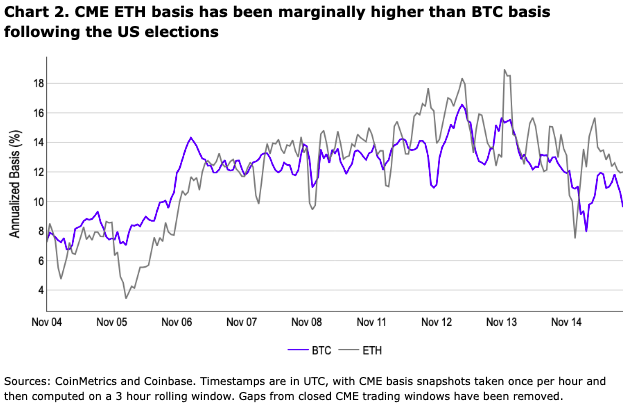
Meanwhile, between November 5 and 13, BTC ETF holdings have increased by 47.8K BTC (from 997.8K to 1.045M BTC), while CME BTC OI has increased by 29.3K BTC (from 166.5K to 195.8K BTC). This represents a comparatively smaller 61% ratio between the net CME BTC OI increase relative to spot ETF inflows. (Note that the CFTC CoT report for the week ending November 5 shows that leveraged funds held 84% of their positions in shorts representing 113.7K BTC.) However, as mentioned above, we believe that that larger short position may have been a result of the basis opportunity leading into the November 5 release date, after which ETH basis became significantly more attractive. (On November 5, BTC basis averaged 8%, while ETH basis averaged 6%.)
13F Filings
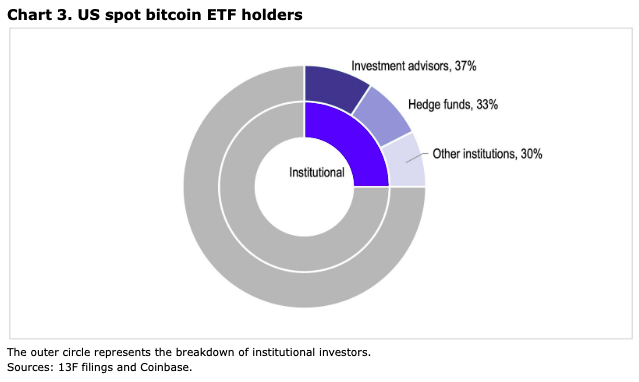
The 3Q24 13-F filings deadline also passed on November 14, revealing institutional ownership of ETFs as of September 30. While this does not encapsulate positioning following the recent rally, it does shed insight into the growing institutional interest in crypto. It is also the first 13-F filing date for most ETH ETFs (with the exception of the Grayscale Ethereum Trust). 354 unique institutions filed for ownership of ETH ETFs, accounting for 14% of their total market cap. Of the shares held by institutional holders, 49% belong to investment advisors while 18% are owned by hedge funds.
In comparison, BTC ETF filers have grown to 1308 distinct institutions, up slightly from 1266 in the previous quarter. Among this cohort, investment advisors own 37% of institutional shares, while hedge funds control 33%. Overall, the institutional ownership of BTC ETFs have grown to 25%, slightly up from 24% in the previous quarter.
Notable new holders for the ETH ETFs include Goldman Sachs ($30M under their advisory arm) and Michigan’s state pension fund ($13.3M) whose holdings in spot ETH ETFs currently surpass their BTC ETF holdings ($9.6M). While Ethereum ETF flows still lag behind that of bitcoin, we think its relatively larger amount of investment advisory holdings may be promising for longer term inflows.
Beam Chain
Meanwhile at DevCon 7 in Thailand, Justin Drake revealed Beam Chain, a “proposed redesign for the consensus layer [of Ethereum]”. In principle, the Beam Chain aims to replace the existing Beacon Chain which currently drives the core of Ethereum’s proof-of-stake consensus mechanism. The proposal is driven by three primary rationales: (1) a better understanding of how to improve MEV, (2) new breakthroughs in zero knowledge technology – SNARKs in particular, and (3) the need to clean up technical debt.
The proposed roadmap categorizes consensus changes into two buckets – those which can be done incrementally and those that are better suited for a single large upgrade. The former includes topics like censorship resistance via FOCIL, improved issuance policies, and smaller validator ETH requirements. These would continue to be rolled out in regular upgrades to the Beacon Chain. The latter, however, would be bundled into a single large and well-tested upgrade akin to “the Merge”. This includes a suite of changes such as shorter block times, faster finality, and a number of cryptographic improvements (e.g. “SNARKifying” the chain’s state transition function). This final large upgrade would target a release in 2029.
Although a timeline of four or five years may sound like a long time, there are several factors that could justify this, in our view. First, this upgrade needs to be performed on an existing system without an “upgrade window”, requiring buildout and testing not only for the new features but also for their transition mechanisms. Second, specifications need to be formalized and finalized before the various client teams begin working in earnest on the new architecture. This communication and consensus overhead slows down the development process, not to mention two new teams are planning to create consensus clients for this upgrade. Last, and perhaps most important, is the extreme focus on testing. Over two years are dedicated to testing the upgrade, more than is projected for the build process itself. Given the high tail risk in the event of any network downtime, this becomes crucial for a trusted network like Ethereum with nearly $60B of total value locked (TVL) on the network.
It’s important to note that the Beam Chain is not a confirmed plan or timeline for Ethereum’s development going forward, nor is it a change to the core components of Vitalik Buterin’s vision for the future of Ethereum. Instead, it focuses on “identifying a subset of that roadmap and accelerating it” as well as putting a “mimetic wrapper” around those changes. The adoption of this roadmap would require major community buy-in in order to execute. Indeed, the proposed timeline involves more than a year dedicated to gathering community feedback and detailing the exact protocol specifications for inclusion.
Crypto & Traditional Overview
(as of 4pm EDT, Nov 14)
|
Asset |
Price |
Mkt Cap |
24 hour change |
7 day change |
BTC correlation |
|
BTC |
$87,875 |
$1.77T |
-3.02% |
+14.86% |
100% |
|
ETH |
$3,106 |
$379B |
-2.80% |
+7.38% |
76% |
|
Gold (Spot) |
$2,568 |
|
-0.17% |
-5.10% |
-33% |
|
S&P 500 |
5,949.17 |
– |
-0.60% |
-0.40% |
70% |
|
USDT |
$1.00 |
$125B |
– |
– |
– |
|
USDC |
$1.00 |
$36.7B |
– |
– |
– |
|
Asset |
MTD flow (US$B) |
YTD flow (US$B) |
AUM (US$B) |
Assets held (BTC/ETH) |
|
Spot BTC ETFs (US) |
$4.03B |
$28.24B |
$94.71B |
1.05M BTC |
|
Spot ETH ETFs (US) |
$0.72B |
$0.24B |
$9.47B |
2.98M ETH |
Source: Bloomberg
Coinbase Exchange & CES Insights
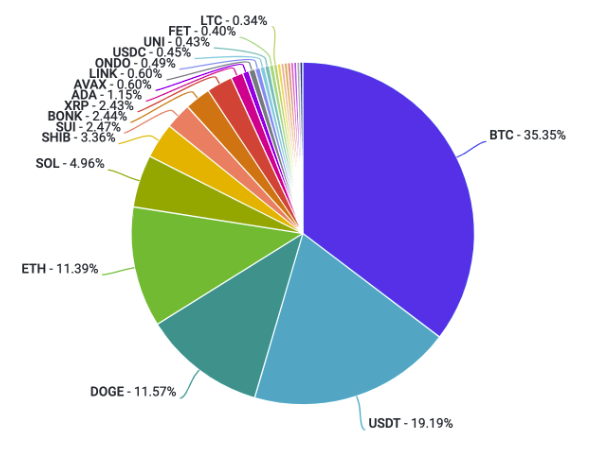
The price momentum that began with the US election outcome continued into this week on elevated volumes. Perp funding rates reached extremely high levels on Tuesday as the traders paid up for long exposure. BTC, ETH, and SOL funding rates were between 60-80% annualized, levels not seen since the March 2024 highs. (High funding rates can pose a risk for price action because they make long positions expensive to hold, and a slow down in momentum can cause traders to close their long exposure and pressure prices.) Funding rates have since come into more sustainable levels around the mid-teens, suggesting positioning has improved. The desk has seen a preference for BTC and little interest in taking profits. Altcoins flows continue to be more balanced with traders using strong rallies as an opportunity to derisk.
Trading volumes on Coinbase platform (USD)
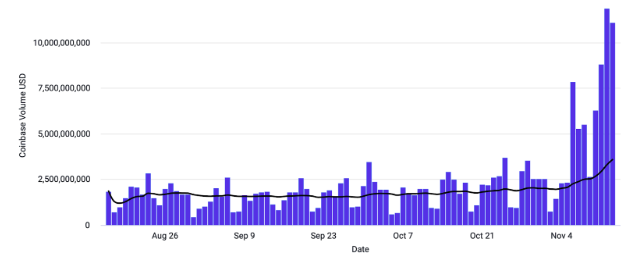
Trading volumes on Coinbase platform by asset